Articles
Amongst the Dead at the Cemetery – Two Who Died in a Shipwreck in Nova Scotia By Steven Mann
The investigation into the accident began at Halifax, Nova Scotia, on Saturday, April 5, 1873, and continued for several weeks. The work of recovering the dead, cargo and valuables has been carried on by fishermen and divers of Marr’s Island. Each day bodies are raised via the grappling-irons until more than 250 had been interred ashore. Most were placed in coffins provided by officials at Halifax, and the bodies not recognized or taken away by friends repose in the Nova Scotia burying-grounds.
When the bodies of all the deceased were first brought ashore, their examination and identification were loosely conducted. In many cases money was taken off their persons. Several men from New York who were looking for deceased friends protested against this. Divers went out to the wreck in boats and dove looking for casualties. They reported that the water was clear and every object easy to see. The following is a description of the interior of the hull as seen by a diver.
“The air from above, which is furnished through the rubber tube, comes with a hissing sound, producing a strange feeling. I shudder at the thought of being immersed so deeply, and how slight an accident would insure instant destruction. All around the objects looked weird-like, the glasses in the casque magnifying the already bloated forms into twice their size. The waters are very cold, and a chilly feeling creeps over me at first, but as I proceed it wears away, and I enter upon the task I have undertaken with more nerve than I fancied I possessed. The immense hull lies down on the port side, which is broken in several places from contact with the reef. Fish were swimming around, eagerly devouring the particles of food which are to be picked up. Picking my way toward the hull, I catch hold of a rope and scramble up the deck. The place where I have descended is where the ship parted, and a sectional view of the hull and cargo is obtained. The forward hatch is open, and I peer down the hold.” And it goes on.
The Atlantic was built by the firm Harland and Wolff in Belfast in 1870. It was the second ship built for the new White Star Line. She had a steam engine producing 600 horsepower driving a single propeller with four masts rigged for sail. She sailed for New York on her maiden voyage on June 8, 1871. She weighed 3,707 tons, and traveled a speed of 14.5 knots.
Today, most of the ship lies fragmented under 40-60 feet of water. Artifacts from several salvage operations can be found displayed at the Maritime Museum of the Atlantic at Halifax, and at the SS Atlantic Heritage Park and Interpretation Center at Terence Bay, Nova Scotia. A monument of the wreck is found at the mass grave in the Terence Bay Anglican Cemetery. A smaller monument marks a second mass grave at the local Catholic cemetery.
At the time, this was the worst maritime disaster for Canada in the 19th century. It is said 546 out of the total 975 on board perished. It is incredible that of those, two are buried at the Poughkeepsie Rural Cemetery while two more are memorialized there, in the same plot.
It is important to note that this is NOT the William Hamilton Merritt (1793-1862) who was a founder of the Welland Canal , born at Bedford, Westchester County, NY. However, that William H. Merritt did die in 1862 aboard a ship near Cornwall, Ontario, Canada and is buried at the Victoria Lawn Cemetery at St. Catherine’s, Ontario, Canada. More ironically, that William H. Merritt’s son was the late Thomas Rodman Merritt, a member of the Canadian House of Commons, who shared the same middle name as the Mary Merritt interred at Poughkeepsie. [Genealogical note: The Rodmans were a wealthy industrialist family with strong connections in the Philadelphia, Pennsylvania area and were Quaker as were the Merritt ancestors.]
And in answer to an unasked question……The Titanic was a White Star Line ship.
Livingston’s Yuletide Legacy by Steven Mann
As part of the recent historic tour of the cemetery cosponsored by the Friends, one of the impersonators was Michael Frazier of Rhinebeck. Michael is a retired local educator and in retirement is serving as Treasurer of the Rhinebeck Historical Society and is a former President of The Museum of Rhinebeck History. He has authored a history of Rhinebeck published by Arcadia Press. He portrayed Abraham Lincoln in Rhinebeck on July 4 and was the perfect choice for portraying Henry Livingston
Henry was the son of Dr. Henry Gilbert Livingston and Susannah Storm Conklin. His grandfather was the noted Capt. Jan Storm, a founder of the First Reformed Church of Poughkeepsie. He was born October 13, 1748, in Poughkeepsie, Dutchess, NY and died February 29, 1828 in Poughkeepsie, Dutchess, NY. He married (1) SARAH WELLES May 18, 1774 in Stamford, CT, daughter of the noted REVEREND NOAH WELLES of Stamford, CT’s First Congregational Church and ABAGAIL WOOLSEY. Sarah was born November 07, 1752 in Stamford and died there in September 01, 1783. At that time he had his children boarded out and he concentrated on writing. He married (2) JANE M. PATTERSON September 01, 1793. She was born January 22, 1769 and died August 26, 1835.
Known as Major Henry Livingston for his service in the Revolutionary War, he was also a Judge, having been appointed by Governor Clinton. Like his father he was a surveyor and map maker by profession. Of course, he may be best known for his prowess as an author. Henry is buried in the Poughkeepsie Rural Cemetery with many other family members. Henry and Sarah had ten children, not all of whom lived to marry. He later had five children with Jane.
During his widowerhood of ten years, the Major was occupied with poetry and drawings for his friends and family, some of which ended up in the pages of NEW YORK MAGAZINE and the POUGHKEEPSIE JOURNAL. Although he signed his drawings, his poetry was usually anonymous or signed simply, “R”.
There has been great controversy over the years about Livingston having written the Christmas poem as it first appeared in the TROY SENTINAL on December 23, 1823. The poem definitely came out of the home of Clement Moore, and the person giving the poem to the newspaper, without Moore’s knowledge, certainly believed the poem had been written by Moore. It is documented, however, that several of Livingston’s children remembered their father reading that very same poem to them a good 15 years prior to the 1823 publication date.
It has been recorded that as early as 1837, Charles Fenno Hoffman, a friend of Moore’s, put Moore’s name on the poem. In 1844, Moore published the poem in his own book, POEMS. At various times in his later life, Moore wrote out the poem in longhand to give to his close friends. Even English department faculty at Vassar College have gotten into the controversy in the last decade and are quite sure Livingston did author the original document.
The mystery remains tucked away, perhaps with the remains of the esteemed Henry Livingston, in his burial plot at the historic Poughkeepsie Rural Cemetery.
Margaret Brainard Hamilton By Steven Mann
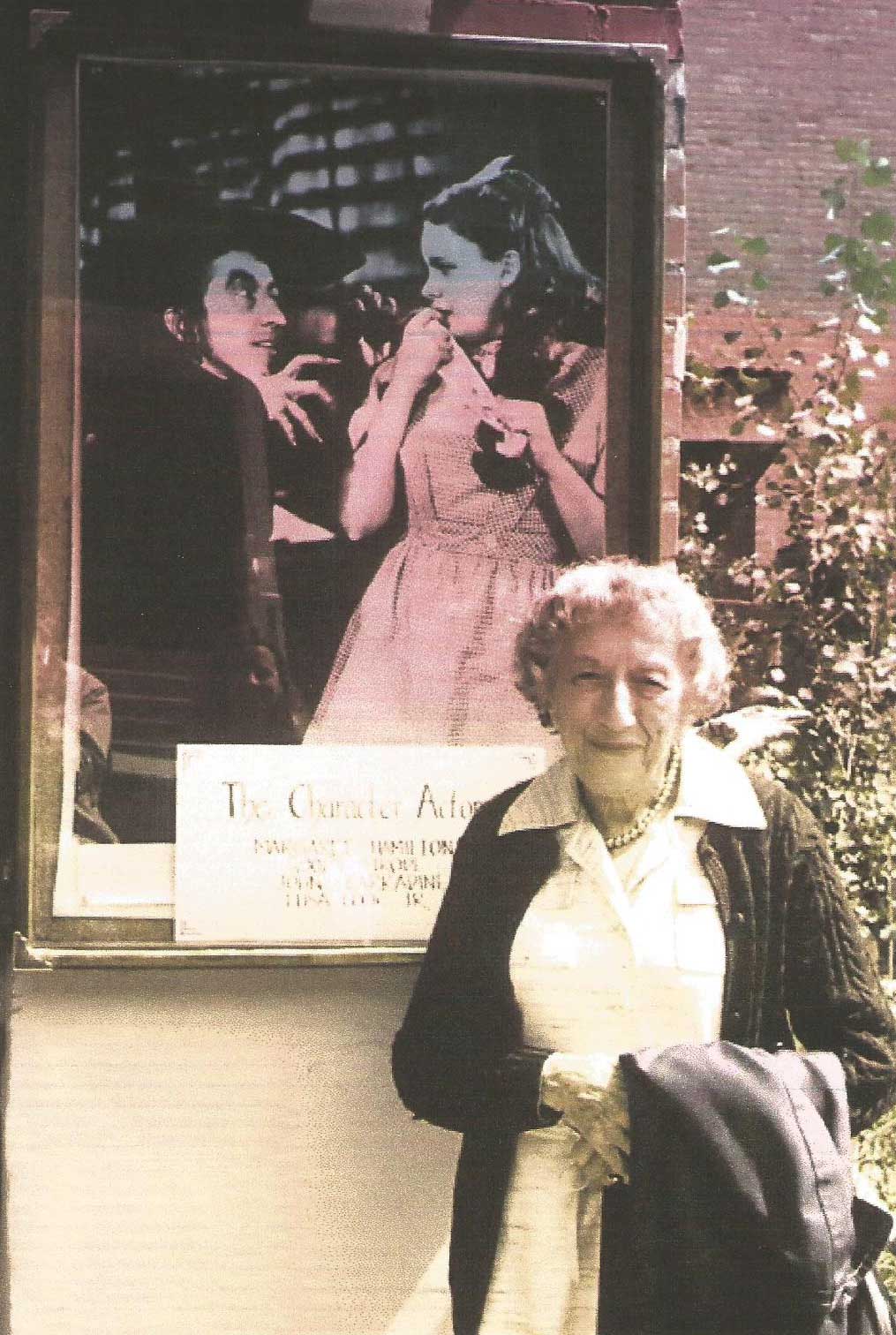
Margaret Brainard Hamilton was cremated in May 1985 at the Poughkeepsie Rural Cemetery, and her ashes were scattered in Amenia, NY, which is not too far from Poughkeepsie.
Margaret was born December 9, 1902 in Cleveland, Ohio, as the youngest of four children to Walter J. and Jennie (Adams) Hamilton. She was educated at the prestigious Hathaway Brown School and Wheelock College in Boston. She was trained to be a kindergarten school teacher, which she did only a short time before becoming a character actress in films for seven years prior to being cast in the Wizard of Oz in 1939, not only as the Wicked Witch of the West, but as Miss Almira Gulch, the kind neighbor of Dorothy Gale and her grandparents. In 1940, she played in My Little Chickadee and in 1948 the less-known Bungalow 13. She worked hard to support herself and her son as a single mother, and she never worked under a studio contract but asked for $1,000 a week for her acting.
Ms. Hamilton remained an active actress for many years, doing commercial and TV sitcom work. She was a noted advocate for children and animals, and public education. In the 1940s-1950s she played in The Couple Next Door, a radio series where she was Aunt Eva/Effie (the name changed). In 1960, she played maid Elaine Zacharides in director/producer William Castle’s 13 Ghosts, a horror film of note at the time. In 1965-6, she played Morticia Adams’ mother Hester Frump in The Addams Family three times. She had turned down the memorable role of Grandmama. During that time she was a regular on the CBS soap opera The Secret Storm as housekeeper Katie. In the early 1970s she played Miss Peterson on the CBS soap opera As The World Turns.
In 1976, she played a witch opposite Oscar the Grouch on Episode #847 on Sesame Street. That same year she played on the Paul Lynde Holloween Special as the housekeeper resembling her earlier Wicked Witch role and introduced Lynde to the rock group Kiss. She also appeared as herself in an episode of Mister Rogers’ Neighborhood. In 1979 and 1982, she played veteran journalist Thea Taft on Lou Grant. She finally retired from acting in 1982, at age 80.
She married Paul Boynton Meserve on June 13, 1931, divorcing in 1938. She never remarried. They had one son, Hamilton Wadsworth Meserve who she solely raised. Her three grandchildren are Christopher, Scott and Margaret Meserve.
She died on May 16, 1985 at age 82 in Salisbury, Connecticut. She will forever be remembered by millions of people throughout the world as the “Wicked Witch of the West” in the Wizard of Oz. According to the website Wikipedia, Ms. Hamilton was ranked #4 in the American Film Institute’s list of the 50 Best Movie Villains of All Time, making her the highest ranked female villain.
by Steven Mann
Judge Jane M. Bolin By Steven Mann
The Smith Brothers By Steven Mann
In 1847, James Smith moved to Poughkeepsie, New York from Quebec, Canada to establish a
restaurant. He had been born in Scotland and emigrated to Canada in 1831. He and his wife
had sons William and Andrew.
In Poughkeepsie James Smith opened an ice cream shop called James Smith and Son. The
restaurant, later known as Smith Brothers, became a Poughkeepsie institution on Market Street.
It was to become as revered by locals as the noted Nelson House. James purchased a cough
drop recipe from a peddler named Sly Hawkins and in 1852 the first batch was produced.
In 1852 James Smith took his first advertisement in the local paper inviting all “afflicted with
hoarseness, coughs or colds” to test his “cough candy” which he began selling on a small scale
circa 1850. ln 1866, following their father’s death, they inherited their father’s business and
the company officially became known as Smith Brothers.
ln 1872 the brothers developed the famed packaging which shows their likenesses. lt was one
of the first “factory filled” packages ever developed in this country. In the Smith Brothers
packaging the word Trade was found under William’s picture and the word Mark was found
under Andrew’s picture. This is how to millions of Americans they became known as Trade and
Mark and not as William and Andrew.
William was the philanthropist and community leader acting on behalf of the brothers. He
donated $140,000.00 to expand the Vassar Warner Home on South Hamilton Street and land in
Southfield, Massachusetts for Camp Wa Wa Segowea.
Andrew, born in 1836, never married and died in 1895. However, his brother William, who was
born in St. Armand, Quebec, Canada had offspring and continued as President of Smith
Brothers almost to his death in 1913. This was the end of the second generation of family
ownership.
After his death, son Arthur G. Smith took over and the business continued to succeed. Menthol
cough drops were added in 1922, a cough syrup in 1926 and the noted wild cherry flavor in
1948. The fourth generation was Arthur’s sons William Wallace Smith and Robert Lansing
Smith. lt was continued as a family business until 1964 when it was purchased by Warner-
Lambert. ln 1977 manufacturing was moved to Chicago, Illinois.
The Smith Brothers are buried in the Poughkeepsie Rural Cemetery.
Information used in the preparation of this article was gleaned from several sources including recent articles in the
POUGHKEEPSIE JOURNAL and from the official Smith Brothers web site
The Trolley Waiting Shelter By Steven Mann
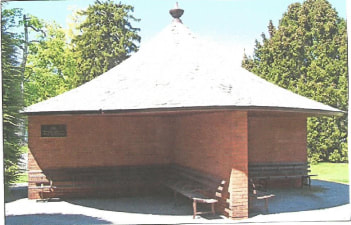 The Trolley Waiting Shelter
The Trolley Waiting Station and the Old Trolley
A joint effort by the Staff of the Cemetery and Steven Mann
Many years ago, Poughkeepsie, like many other cities in America, had a trolley system with tracks that ran down the main streets. The trolley waiting shelter immediately north of the Poughkeepsie Rural Cemetery’s main entrance is a relic from that. Constructed of red brick with a wooden shingle roof the circular structure with its built-in benches was used as an outdoor waiting room for those who needed to get on the trolley to reach work, home, go shopping, to school, worship, etc. The shelter is now most visible given the necessary revamping of the cemetery’s main entrance landscape and is an incredible sight that had been hidden by large dense hemlocks.
At some point in his multi-faceted and diversified business career, James W. Hinkley, Sr., of the estate Eden Hill on the south end of the city of Poughkeepsie, purchased the old Poughkeepsie City Railroad Company. He then organized the Poughkeepsie City and Wappinger Falls Railway Company. He served as president until death in 1904 at age 53.
Previous to this he had edited and owned the News-Press of Poughkeepsie and later the Daily Graphic in New York City, which was the first illustrated daily newspaper in the world. Both were pioneers in the field of journalism, employing women in their editorial departments as early as 1883. Perhaps Mr. Hinkley became emerged in transportation after having become involved in the operation of an electric manufacturing company which made motors and generators. This was The Walker Company, which Westinghouse Company later purchased. We can only surmise this could have been.
Upon purchasing the Poughkeepsie City Railroad Company, horse-drawn trolley car service ran along the tracks in the city of Poughkeepsie. They were later electrified and an expansion of track was made to the north and south of the city. The Wappingers Falls line began running October 1, 1894. Modern urban growth became possible and successful with help from the trolley system. Until World War I, the lines grew and bustled. However, that growth eventually stopped when bus service began in October 1928, quickly taking the place of the trolleys.
Mrs. Mary Hinkley, wife of James W. Hinkley, donated the trolley waiting shelter at the cemetery. Many, but not all, of the riders who got on or off from the cemetery were workers at the cemetery who lived in Wappingers Falls. Today the shelter has been restored with funding provided by The Friends of the Poughkeepsie Rural Cemetery. We may never again hear the “clang, clang, clang” of the trolley, but we can sit in the trolley waiting station remembering nostalgia of the past while enjoying the beauty of the Poughkeepsie Rural Cemetery, once a stop on the local trolley.
Smith Thompson – US Supreme Court Justice By Steven Mann
An Unassuming Gentleman By Steven Mann
The Poughkeepsie Pottery By Steven Mann
The Sundial Monument by Steven Mann
Browse Photo Gallery
Of our beautiful cemetery grounds.


Là où certaines plateformes déçoivent après quelques sessions, cazeus parvient à maintenir l’enthousiasme sur la durée. La plateforme propose des bonus spéciaux pour les joueurs qui préfèrent les jeux de table aux machines à sous. Un calendrier d’événements régulièrement actualisé informe des prochaines animations et promotions. Les jeux de type game show interactifs apportent une dimension spectaculaire inspirée des émissions télévisées. On ne peut que saluer l’effort continu de cette plateforme pour rester au sommet de son art.